Don't Miss




 to add an item to your Itinerary basket.

Located only four miles from the coast, Cleator Moor is the gateway to the beautiful Ennerdale valley. Dent Fell, sometimes known as Long Barrow, sits in a commanding position on the town’s skyline and is one of the first fells walkers climb on Wainwright’s famous Coast to Coast walk. It offers impressive views of the Cumbrian Coast and Lake District mountains.
Walkers and cyclists will enjoy following the old railway line from Whitehaven to Ennerdale, which runs through Cleator Moor. The track, which has now been tarmacked, is part of the West Cumbria cycle network, and forms part of the Sustrans C2C cycle route from Whitehaven to Sunderland.
Culture and Heritage
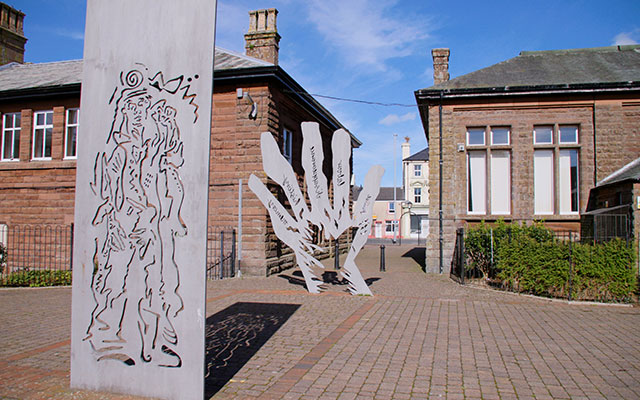
Photo: Adamediafilm.com
This former mining town has strong links to the arts and in the market square you will find three sculptures by celebrated artist Conrad Atkinson. Conrad was born in the town in 1940 and he created these special works as a memorial to the town’s once thriving mining industry – they are known as the Miner, the Phoenix and the Hand.
Another internationally famous artist associated with the town is L S Lowry, who paid regular visits to stay with friends. He painted Cowles fish and chip shop, amongst other things, The Co-op on Market Square and the former Westminster Bank, which is now a café. There is a blue plaque to Lowry outside the public library on Market Square.
West Cumbrian artist Percy Kelly, who is famous for his paintings of towns and villages along the Cumbrian coast, also painted scenes of the town. The Millom born poet Norman Nicholson wrote about the mine at Cleator Moor and the lives of its workers, providing a moving insight into the town’s social history.
There is a long history of iron ore and coal mining have in West Cumbria, local monks mined iron ore as far back as the 12th century. Rapid expansion came with the industrial revolution and by the mid-1800s Cleator Moor had grown from a small village into a busy industrial town, with a large population of migrant workers from Ireland, leading to the colloquial title of Little Ireland. Today, all the mines have closed, but a fascinating insight into the region’s industrial past can be gleaned by visiting The Beacon Museum in Whitehaven.
St Mary’s church was designed by E.W. Pugin and opened in 1872, during the economic depression of the 1920s the priest at St Mary’s raised funds to build a shrine to Our Lady. Built by local volunteers who received food and clothing vouchers in return for their labour, the shrine was a replica of the Grotto at Lourdes. International travel at the time was limited so the Grotto became a place of pilgrimage, it was dedicated by Cardinal Basil Hume in 1980.
What’s nearby
- The historic harbour town of Whitehaven is home to The Beacon Museum and The Rum Story
- Ennerdale Water, which is the only road-free lake in the whole of the Lake District, offers visitors tranquillity and spectacular scenery
- Cleator Moor is on the Sea-to-Sea (C2C) Sustrans cycle route (NCN 71) which links Whitehaven with Sunderland and Newcastle.
the western lakes has a rich history, brilliantly told

Search
- Accommodation
- Things to Do
- What's On
- Food & Drink
-
Towns & Villages
Accommodation
Things to Do
What's On
Food & Drink
Accommodation
Things to Do
What's On
Food & Drink
Towns & Villages
Towns & Villages
Number of results: 21
, currently showing 21 to 21.

Address
Campbell-Savours Way, WORKINGTON, Cumbria, CA14 3DZWORKINGTON
Centrally located multi-storey car park with 427 spaces.
Height restrictions: 1.98m Open 7 days a week.
Public toilets adjacent to the car park.
You may also like
Follow The Lake District, Cumbria on Social Media
Receive all the latest news, special offers and information from the Lake District, Cumbria

Ratings Powered By


© Cumbria Tourism