Don't Miss




 to add an item to your Itinerary basket.

Coniston village is especially popular with walkers and outdoor enthusiasts primarily because of its position – at the foot of one of Cumbria’s most popular fells, the Old Man of Coniston and by the western shore of Coniston Water, at 5 miles (8km) long one of England’s largest lakes. A relic fish from the Ice Age, the Arctic Char, still inhabits these waters.
Born on the back of the copper mining and slate quarrying industries, the village today has a thriving economy based on walking, sightseeing, water sports, mountaineering, horse riding and the consumption of real ale!
North of Coniston, two spur roads lead to Tilberthwaite and the old slate quarries, now carved into a distinctive landscape of huge spoil heaps and gaping rock chasms.
Food & Drink in Coniston
Coniston is spoilt for choice with many of its cafes and restaurants having beautiful lake vistas, or are even sited by Lake Coniston itself. How about sitting on a cosy sofa in a Farmhouse tearoom overlooking the lake, or take your coffee, or perhaps something more substantial, on a café terrace, with unrivalled views across the Lake.
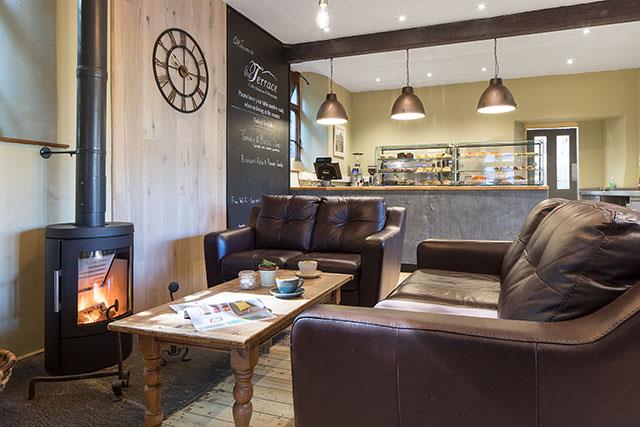 Many of the pubs, restaurants and cafes have intimate settings, which are warm and cosy and offer a variety of locally sourced, award-winning foods. There’s everything from Indian food, making a very good choice for vegetarians, to a marvellous selection of traditional pubs with roaring log fires, a warm and friendly service, either in the town itself or in nearby Torver.
The selection of beers are second-to-none, with Coniston having its own local brewery, there is much to try from the Bluebird Bitter to Coniston Old Man Ale.
Portions are often generous without skimping on quality with many eateries being dog-friendly. There’s classy Bistros with beautifully presented inventive cuisine and several of the eating establishments in Coniston aren’t licenced, so you need to BYOB. What better way to enjoy first class food at affordable prices.
Whatever the weather, couples and families will always find somewhere to relax and unwind and enjoy the very best of Cumbrian cuisine and hospitality.
Coniston - Culture & Heritage
This area’s history is defined by sheep, copper and slate. In the 16th century, rich seams of copper ore were found in Coppermines Valley. With little local mining expertise, German miners were drafted in to work the copper veins. Peak output for the mines was the middle of the 19th century, when most of the copper was used to line the hulls of wooden sailing vessels.
Falling copper prices and greater competition from overseas resulted in a gradual decline and the closure of the mines in 1915 – but the legacy is still visible in the abandoned shafts and open workings that are still pretty dangerous to wander into.
Much of this area was formerly monastic land owned by Furness Abbey which made its money from sheep farming, and iron ore mining and smelting. One of their estates was at Monk Coniston, now owned by the National Trust.
They bred the local Herdwick sheep – from the old Norse for ‘sheep farm’ – whose distinctive grey fleeces and short, sturdy legs were particularly suited to the rigours of living on the open fells. Many Lakeland hill farms continue to farm this old breed.
Slate quarrying developed during the 17th century in response to increased demand for building materials, particularly roofing slates. The quarries at Tilberthwaite and on the ‘Old Man' were mined systematically for around 200 years and one or two are still in operation today.
Quarrying and mining were so profitable that in 1859 a railway was built to bring out the copper and slate. In later years, the railway brought the first tourists to the area, but was subsequently closed in 1964.
Clearly such heavy industry did little to spoil the area’s natural beauty as early tourists still came to marvel at the region’s natural beaty. The influential 19th century writer and social reformer John Ruskin was so enchanted by the landscape that he once declared his house on the eastern shore of Coniston Water – a nice pile called Brantwood – to have ‘the best view in all of England.’
Did you know?
JOHN RUSKIN
John Ruskin (1819-1900), one of the most influential critics, thinkers and social reformers of his day, who inspired Tolstoy, Proust, Shaw, Oscar Wilde, the first Labour MPs, and Gandhi, amongst others. Revolted by industrialisation and rampant capitalism, he revived the local linen industry, the museum houses the finest collection of Ruskin Lace in the world.
DONALD CAMPBELL (1921–1967)
Coniston Water was the scene of an ill-fated attempt by Donald Campbell to break the water speed record. On 4 January 1967, Donald was at the helm of Bluebird K7 and travelling at around 320 mph when the boat somersaulted into the air and disappeared into the water. It was not until 2001 that the remains of Bluebird were raised from the lake bed, and has subsequently been restored and brought back to Coniston, where it can be seen in the specially built ‘Bluebird Wing’ of the Ruskin Museum.
SIMON’S NICK
Simon’s Nick, ‘a fearsome crack in the rocks below Levers Water’, was where a seam of copper was worked by a miner called Simon Puchberger. He was blown up by his own explosives. His ghost is said to haunt the mine to protect what remains of the copper ore.
HALIFAX BOMBER
In October 1944 a Halifax Bomber crashed into Great Carrs, a steep mountain side behind Wetherlam. All on board were killed. One of the engines can be seen outside the Ruskin Museum.
OLD MAN OF CONISTON
'The ‘Old Man of Coniston' (SD 272 978) rising dramatically behind Coniston is one of the highest mountains in Cumbria at 803 metres. The ‘man' is the large cairn on the summit.
GERMANIC SURNAMES
The influx of German miners in the 16th century has left a legacy of Germanic surnames and patronyms among Coniston’s residents today, such as the Calkers, Knipes and Zinagles (now Senogles).
Highlights

Located on the shores of Coniston Water with sensational lake and fell views, this classic Lakeland…
Whatever your ability level, Grizedale is a fantastic place to get on the trail and enjoy the fresh…
Coniston Old Man, rises dramatically to its height of 2635ft. Also known as the 'Old Man of…
Located on the shores of Coniston Water with sensational lake and fell views, this classic Lakeland…
Backed by low fells and woodland, the western shore of Coniston Water is a delightful place for a…
Based in the heart of the Lake District adventure awaits. Whether you’re a thrill-seeker looking…
The Bluebird Cafe, Coniston boast an idyllic location the the shores of Coniston Water. Open daily…
Yewdale, Arnside Intake, Tarn Hows and Monk Coniston make up an intricate network of small valleys…
Covering 112 miles, and the most famous passes of the Lake District, the 4 Seasons Fred Whitton…
Explore Coniston Water - one of the Lake District's famous lakes and see the magnificent scenery…
Buses to and through Coniston: Coniston Rambler 505 Ambleside - Hawkshead - Coniston. X12…
SUP Paddleboarding by Genuine Adventures offers a serene glide across Lake District waters, guided…
Near Satterthwaite, Grizedale, Ambleside. Known locally as Force Forge. In open woodland.
Discover the Lake District after dark on an unforgettable canoe journey across beautiful Coniston…
• Sleeps up to 16 • 3 inter-linking cottages, can be booked individually sleeping 2-8 or together…
• Sleeps 4 • Mountain hot tub with incredible views of Coniston Old Man • 2 bedrooms and 2…
Generally you expect to find long rolling descents on mountain bike routes in the higher peaks and…
Thornthwaite Farm is set amidst the beautiful scenery of the Woodland Valley. We have four…
Educational farm business, involving learning about the farm and Herdwick Sheep, including meeting…
On-site cafe/restaurant serving teas, coffees and light lunches all homemade on the premises.…
Enjoy cruising aboard our launches around beautiful Coniston Water. A personal commentary by our…
Most of the low fells East of Coniston Water are covered by woodland and forestry plantations. The…
In the Rusland Valley, an unspoilt valley between Windermere lake and Coniston Water, close to…
Covering 112 miles, and the most famous passes of the Lake District, the 4 Seasons Fred Whitton…


The Lake District Where modern tourism was born
.jpg)
Search
- Accommodation
- Things to Do
- What's On
- Food & Drink
-
Towns & Villages
Accommodation
Things to Do
What's On
Food & Drink
Accommodation
Things to Do
What's On
Food & Drink
Towns & Villages
Towns & Villages
Number of results: 103
, currently showing 101 to 103.

Address
National Trust Tarn Hows, Ambleside, Cumbria, LA22 0PPAmbleside
Pay & Display Car park with 68 spaces.
Public toilets adjacent to the car park.
Address
Birchbank Farm, Birchbank, Subberthwaite, Ulverston, Cumbria, LA12 8EWTelephone
01229 885277Subberthwaite, Ulverston
Small camping site half mile from Tottlebank between Windermere and Ulverston. See website for more details.
Address
Grizedale, Cumbria, LA22 0QQGrizedale
Automatic Number Plate Recognition (ANPR) – please pay on exit.
You may also like
Follow The Lake District, Cumbria on Social Media
Receive all the latest news, special offers and information from the Lake District, Cumbria

Ratings Powered By


© Cumbria Tourism